Creative Suite 5 is nearly upon us – so close I am already nudging our resident sys admin to buy us the shiny new apps. Obviously, there are many new features / changes to encourage people to upgrade.
One such that certainly sounds interesting, is a tool providing the ability to export flash as HTML5 Canvas. With IE9 on the horizon too, this will mean all of the major browsers will support HTML5, a step towards making this a viable alternative to the Flash plug-in. More on this here and again with a performance comparison between Flash and HTML5 here.
As you may or may not have heard by now, another eagerly anticipated feature was the ability to export flash apps as iPhone code. Apple have very recently announced that they have changed the way their SDK works – only code written in C, C++ or Objective-C may compile and directly link against the Documented APIs. Cross-compilers, such as that advertised to be in the new CS release, are apparently banned. This will potentially affect a number of other technologies (e.g. Unity3D), but the Adobe link is the most publicised given the public deterioration in their relationship with Apple.
Given this bad blood between Apple and Adobe, the cynical might wonder if the announcement was deliberately timed to dampen the build up to the CS5 launch. It is definitely a blow to the product, and prompted an Adobe employee to post a frustrated response to the move (more here, including links). Steve Jobs has since responded to this (more here) with a customarily curt reply, not giving any hope to those hoping for Apple to change their mind.
Nevertheless, I am still looking forward to trying the new Creative Suite, even without the opportunity to try my hand at iPhone development. More on CS5 here.
Nick Nawrattel
Lead Multimedia Developer
Showing posts with label rich media. Show all posts
Showing posts with label rich media. Show all posts
Tuesday, 13 April 2010

Tuesday, 21 April 2009
Design for Multimedia
Multimedia has the potential to produce immersive, rich and creative websites. The process of designing and developing a multimedia site can have some significant differences to that of a static HTML site - the variety of media on offer can broaden the design canvas.
For example, similar to a movie, sound effects and music can dramatically improve the impact of a film. The same can be said for web elements like navigation, rollover effects and the overall user experience.
There can be a tendency to overcomplicate or over-design elements, thus overwhelming the user. It is important to balance the interactive elements with the complexity of the design to better appeal to the target audience.
From our perspective however, portraying the whole user experience can be difficult to adequately convey to the client. As the designs for the site will be initially mocked up as static pages, the client may be restricted by this and find it difficult to see the big picture, with all its wooshy bits! The best method to overcome this is to produce a storyboard of the user experience to demonstrate the multimedia designers/developers ideas in as much detail as possible. Similar real-life examples can also be given to help the client visualise how the site will work.
Being both a developer and designer allows me to carefully balance visually rich sites while still anticipating any potential development issues. This process aids in a much smoother project life cycle and some great looking sites!
Richard Fenn
Multimedia Designer
For example, similar to a movie, sound effects and music can dramatically improve the impact of a film. The same can be said for web elements like navigation, rollover effects and the overall user experience.
There can be a tendency to overcomplicate or over-design elements, thus overwhelming the user. It is important to balance the interactive elements with the complexity of the design to better appeal to the target audience.
From our perspective however, portraying the whole user experience can be difficult to adequately convey to the client. As the designs for the site will be initially mocked up as static pages, the client may be restricted by this and find it difficult to see the big picture, with all its wooshy bits! The best method to overcome this is to produce a storyboard of the user experience to demonstrate the multimedia designers/developers ideas in as much detail as possible. Similar real-life examples can also be given to help the client visualise how the site will work.
Being both a developer and designer allows me to carefully balance visually rich sites while still anticipating any potential development issues. This process aids in a much smoother project life cycle and some great looking sites!
Richard Fenn
Multimedia Designer
Wednesday, 30 July 2008
AS3 & Bluhalo's Multimedia Department
What’s it like working in Bluhalo’s Multimedia department? Well, we get to make really really cool websites!
Full flash sites may be on the decline, but clients are always demanding engaging elements to bring their sites to life (on a side note, it will only be a matter of time until full flash sites of the late 90’s, early 2000, will be back in full force). Working on a full flash site usually gives us free reign to exert our creativity in bringing the site to life.
As well as creating wooshy animations we also produce rich robust systems that integrate several programming languages, e.g. PHP, XML etc. The integration of these areas of web development merges the different departments at Bluhalo, creating a close-knit team.
With more challenging projects entering the studio, ActionScript 3 has been the main port of call to construct successful products. Although AS3 is relatively new it has greatly improved productivity, speed of production and structured procedures. As AS3 is the integral language for Flex, the program has been introduced to the studio to compliment Flash. With a steep learning curve converting from AS2 to AS3, knowledge-sharing has been key in improving our skills and this is not just isolated to the Multimedia team, but throughout the Bluhalo studio.
Other cool stuff accompanied AS3, like the new and improved Papervison3D engine, enabling smooth 3D interaction.
Most importantly is the fact that our lunch hour consists of button bashing and remote flinging on the office Wii. Periodically tournaments are organised, but winning is overrated *grinding teeth* (not a sore loser from Bluhalo Wii Wimbledon!)
The multimedia team is relatively small in size but this enables us to discuss and create our own procedures, controlling how we work. As the ever demanding roll of an Action Scripter evolves, the future of the Multimedia Team has great potential for growth and promises to have a very exciting future.
Fenn
(We are also recruiting for an ActionScript 3.0 Developer at the moment – check out our careers page for more info!)
Full flash sites may be on the decline, but clients are always demanding engaging elements to bring their sites to life (on a side note, it will only be a matter of time until full flash sites of the late 90’s, early 2000, will be back in full force). Working on a full flash site usually gives us free reign to exert our creativity in bringing the site to life.
As well as creating wooshy animations we also produce rich robust systems that integrate several programming languages, e.g. PHP, XML etc. The integration of these areas of web development merges the different departments at Bluhalo, creating a close-knit team.
With more challenging projects entering the studio, ActionScript 3 has been the main port of call to construct successful products. Although AS3 is relatively new it has greatly improved productivity, speed of production and structured procedures. As AS3 is the integral language for Flex, the program has been introduced to the studio to compliment Flash. With a steep learning curve converting from AS2 to AS3, knowledge-sharing has been key in improving our skills and this is not just isolated to the Multimedia team, but throughout the Bluhalo studio.
Other cool stuff accompanied AS3, like the new and improved Papervison3D engine, enabling smooth 3D interaction.
Most importantly is the fact that our lunch hour consists of button bashing and remote flinging on the office Wii. Periodically tournaments are organised, but winning is overrated *grinding teeth* (not a sore loser from Bluhalo Wii Wimbledon!)
The multimedia team is relatively small in size but this enables us to discuss and create our own procedures, controlling how we work. As the ever demanding roll of an Action Scripter evolves, the future of the Multimedia Team has great potential for growth and promises to have a very exciting future.
Fenn
(We are also recruiting for an ActionScript 3.0 Developer at the moment – check out our careers page for more info!)
Thursday, 26 June 2008
Open Source vs Library vs Ad Hoc
Depending on your requirements, there are different approaches that may be taken in creating a website. What are they (lets pretend you haven’t already read the title)? What advantages do they bring? What do we at Bluhalo advocate?
The first one we will consider is open source software. Although there are a number of different licence flavours, at its most basic open source software can be thought of as free code. What this code does depends entirely on the type of software. For example, there are entire ecommerce solutions available that can be installed and simply require customisation to use. At the other end of the open source spectrum (that we are interested in) would be simple components, intended to achieve a very specific purpose. Somewhere in the middle is the concept of frameworks – varying quantities of code designed to facilitate ad hoc development (more on that later).
So why would you go the open source route? Assuming you can find something that meets your needs, speed of development is greatly increased. Also, if the community for the project is active, it has likely been well tested, meaning there should be very few bugs. The flip side of this is that if there is little community interest or input, projects can stagnate and die - what may initially appear to be a great solution ends up requiring far more time to correct than anticipated, and since it requires working on existing code it potentially forces the developer to work in a way that might not best match their work flow.
To get over the last point, you come to the possibility of building and maintaining a library of your own code. While it can take time to accumulate a meaningful library, it will be code that you know intimately so should be fully aware of what it is capable of. Rigorous testing would also allow you to overcome the lack of a community in ensuring that it is stable and reliable. Precisely what you maintain is very much down to personal preference – some prefer it to be a number of often used functions, while others may prefer to create extensive frameworks for different types of project that can easily be rolled out at need.
The problem with the latter (and with the larger open source solutions) is that they don’t always precisely match requirements – there may be redundant code or features, or they simply may not provide functionality required by the client. Here we come to ad hoc development – crafting a web application precisely according to the needs of the client. While this is more time consuming, it does mean that the final solution will more exactly match what was requested.
As with everything in life, there are advantages and disadvantages to each. If only we could pick and choose! So how is it done at Bluhalo? Here we can give a knowing and reassuring smile. :) We aren’t locked into any one practise.
For example, a smaller business in need of an ecommerce solution with a limited budget will be pointed toward our Dreams division. In this case, they will carefully customise an open source solution with which they are intimately familiar (i.e. tried and tested!) to give the client the best possible balance for their needs.
We also use an open source framework, Symfony, that is gaining a large following around the world. As I mentioned earlier, a framework is designed to aid development – it prevents the programmers from having to re-invent the wheel on every site and instead allows them to concentrate on the nuts and bolts of what makes the clients’ site unique. This has a hugely positive affect on the time it takes to develop a proprietary site.
We also maintain a code library - if a client wanted a simple mp3 player (yay, finally a multimedia example!), we would start with our library player. This is an existing basic player that I wrote previously, and then adjust it functionally and visually to precisely meet the clients requirements. Why waste their valuable studio time unnecessarily?
Basically then, we don’t fall into the trap of relying on a single practice and forcing it around the requirements we are given. The needs for each site will be unique, so we adjust our methodology according to what will give you the best result.
Nick
The first one we will consider is open source software. Although there are a number of different licence flavours, at its most basic open source software can be thought of as free code. What this code does depends entirely on the type of software. For example, there are entire ecommerce solutions available that can be installed and simply require customisation to use. At the other end of the open source spectrum (that we are interested in) would be simple components, intended to achieve a very specific purpose. Somewhere in the middle is the concept of frameworks – varying quantities of code designed to facilitate ad hoc development (more on that later).
So why would you go the open source route? Assuming you can find something that meets your needs, speed of development is greatly increased. Also, if the community for the project is active, it has likely been well tested, meaning there should be very few bugs. The flip side of this is that if there is little community interest or input, projects can stagnate and die - what may initially appear to be a great solution ends up requiring far more time to correct than anticipated, and since it requires working on existing code it potentially forces the developer to work in a way that might not best match their work flow.
To get over the last point, you come to the possibility of building and maintaining a library of your own code. While it can take time to accumulate a meaningful library, it will be code that you know intimately so should be fully aware of what it is capable of. Rigorous testing would also allow you to overcome the lack of a community in ensuring that it is stable and reliable. Precisely what you maintain is very much down to personal preference – some prefer it to be a number of often used functions, while others may prefer to create extensive frameworks for different types of project that can easily be rolled out at need.
The problem with the latter (and with the larger open source solutions) is that they don’t always precisely match requirements – there may be redundant code or features, or they simply may not provide functionality required by the client. Here we come to ad hoc development – crafting a web application precisely according to the needs of the client. While this is more time consuming, it does mean that the final solution will more exactly match what was requested.
As with everything in life, there are advantages and disadvantages to each. If only we could pick and choose! So how is it done at Bluhalo? Here we can give a knowing and reassuring smile. :) We aren’t locked into any one practise.
For example, a smaller business in need of an ecommerce solution with a limited budget will be pointed toward our Dreams division. In this case, they will carefully customise an open source solution with which they are intimately familiar (i.e. tried and tested!) to give the client the best possible balance for their needs.
We also use an open source framework, Symfony, that is gaining a large following around the world. As I mentioned earlier, a framework is designed to aid development – it prevents the programmers from having to re-invent the wheel on every site and instead allows them to concentrate on the nuts and bolts of what makes the clients’ site unique. This has a hugely positive affect on the time it takes to develop a proprietary site.
We also maintain a code library - if a client wanted a simple mp3 player (yay, finally a multimedia example!), we would start with our library player. This is an existing basic player that I wrote previously, and then adjust it functionally and visually to precisely meet the clients requirements. Why waste their valuable studio time unnecessarily?
Basically then, we don’t fall into the trap of relying on a single practice and forcing it around the requirements we are given. The needs for each site will be unique, so we adjust our methodology according to what will give you the best result.
Nick
Monday, 16 June 2008
Video Formats for the Internet
Many websites now use video within their domain whether it be for fun or for marketing purposes. However, to view all of the video that you could watch on the net, you will need various players and codecs (compression-decompression) installed on your PC or Mac. This article is a brief explanation of the most common formats and suggestions as to which to use in certain situations.
Windows Media Format (video files end in .wmv)
This is a video format developed by the Microsoft corporation. Until 3 or so years ago, this was pretty much the defacto standard in use on the net. On a non windows based computer you will need either Windows Media player for your platform if it exists or a plugin (which is generally free) to be able to view the videos.
Quicktime (video files end in .mov)
This is Apple’s version of video format. It’s not as common to find as Windows Media but similarly you will need either the correct player or a free plugin for your current video player.
Real Video (videos end in .ram or .rm)
Developed by Real Media this format is not as common as the previous two formats and has, to an extent, always had to battle to keep up. It is commonly used for audio streaming for the likes of internet radio stations and handles low bandwidths well.
Flash Video (video files end in .flv)
Flash video by Adobe is the latest standard for VOD (Video on Demand) delivery over the internet. Although perhaps not as good a Windows Media for quality under compression, it has more “viewers” than the other standards due to the fact that flash player is installed in nearly every browser. The use by www.youtube.com and google has pushed its dominance in the market.
Although Flash video has greatest penetration, it is used primarily for on demand video. Sites such as youtube compress the video further than most sites need to but as a cheap solution to video it works very well. However, historically, due to cost implications it is not used for live streaming. This domain currently still belongs to Microsoft Windows Media. The Windows Media server is free, or at least part of the Windows server operating system when you purchase it and the majority of “live” broadcasts are still in this format. This will no doubt change in the near future as things progress and it will be interesting to see the implications of these formats on mobile devices.
Steve Furminger
Head of Digital
Windows Media Format (video files end in .wmv)
This is a video format developed by the Microsoft corporation. Until 3 or so years ago, this was pretty much the defacto standard in use on the net. On a non windows based computer you will need either Windows Media player for your platform if it exists or a plugin (which is generally free) to be able to view the videos.
Quicktime (video files end in .mov)
This is Apple’s version of video format. It’s not as common to find as Windows Media but similarly you will need either the correct player or a free plugin for your current video player.
Real Video (videos end in .ram or .rm)
Developed by Real Media this format is not as common as the previous two formats and has, to an extent, always had to battle to keep up. It is commonly used for audio streaming for the likes of internet radio stations and handles low bandwidths well.
Flash Video (video files end in .flv)
Flash video by Adobe is the latest standard for VOD (Video on Demand) delivery over the internet. Although perhaps not as good a Windows Media for quality under compression, it has more “viewers” than the other standards due to the fact that flash player is installed in nearly every browser. The use by www.youtube.com and google has pushed its dominance in the market.
Although Flash video has greatest penetration, it is used primarily for on demand video. Sites such as youtube compress the video further than most sites need to but as a cheap solution to video it works very well. However, historically, due to cost implications it is not used for live streaming. This domain currently still belongs to Microsoft Windows Media. The Windows Media server is free, or at least part of the Windows server operating system when you purchase it and the majority of “live” broadcasts are still in this format. This will no doubt change in the near future as things progress and it will be interesting to see the implications of these formats on mobile devices.
Steve Furminger
Head of Digital
Thursday, 5 June 2008
ShortList site launch
Following the successful launch of ShortList.com, the website for ShortList, the free men's magazine that launched last year, we are pleased to bring you press coverage of the site launch in NMA. The site focuses on interactivity and building traffic levels.

Click image for a larger view of the article.
To view the site visit www.shortlist.com.

Click image for a larger view of the article.
To view the site visit www.shortlist.com.
Tuesday, 3 June 2008
Congrats to SWRT!
Following the launch of the new WRC2008, SWRT's Solberg and Mills finished the Acropolis Rally of Greece this weekend in second place overall.
As SWRT's Official Technical Partner, the team at Bluhalo would like to extend its congratulations at this fantastic success in the first rally event in the new car!
In an extract from the event bulletin, Petter Solberg commented: “Ah! This is just incredible! I am so, so pleased. I can’t put it into words!” exclaimed an excitable Solberg. “It is so good to be back here again, and so important. I’m so happy for the team who’ve put in so much work to get this car ready. It’s incredible, I can’t believe it. First time in the new car, second is not bad at all! We knew it would be tough here but to finish second is just great. It’s what everyone has been waiting for. Phil and I, the team, the fans, everybody. This car has so much potential, I mean so much. This is it, we’re coming back!”
You can read the full event bulletin on the SWRT website and for some great imagery of the new car, visit the new microsite An Icon Evolves.
As SWRT's Official Technical Partner, the team at Bluhalo would like to extend its congratulations at this fantastic success in the first rally event in the new car!
In an extract from the event bulletin, Petter Solberg commented: “Ah! This is just incredible! I am so, so pleased. I can’t put it into words!” exclaimed an excitable Solberg. “It is so good to be back here again, and so important. I’m so happy for the team who’ve put in so much work to get this car ready. It’s incredible, I can’t believe it. First time in the new car, second is not bad at all! We knew it would be tough here but to finish second is just great. It’s what everyone has been waiting for. Phil and I, the team, the fans, everybody. This car has so much potential, I mean so much. This is it, we’re coming back!”
You can read the full event bulletin on the SWRT website and for some great imagery of the new car, visit the new microsite An Icon Evolves.
Friday, 30 May 2008
Multimedia Platforms and Their Design Considerations
Rich media content can appear in many forms: advertising, POS, exhibition stands etc in which a variety of issues have to be considered. More so for the World Wide Web.
The main issue is that of file size, where it is important to weigh up the content versus the download time. Although we may live in a time of high speed broadband, consideration must be made for the 8% of UK users still connecting via dial up or a low broadband speed (http://www.webuser.co.uk/news/256799.html, correct as of 2008). It is still possible to develop two versions for hi and low speed users, however this may be more frustrating for the user. Unable to view the rich content he/she may feel resentful at being forced to “miss out” on the cool stuff.
Rich content such as Flash on the web can be easily customizable for the client to control the look and feel of their own website (certain section) without too much difficulty (i.e.www.tottenhamhotspur.com, www.swrt.com).However not everyone has flash (although it is very easy to install) and because of this an alternative has to be considered.
Interactivity is not necessarily just for web, offline products also require careful thought in the user interface interaction, for example Salon Reception is a standalone desktop application which we are currently developing. Along with this interactivity testing must be fulfilled to ensure a pleasurable experience.
The advantage of developing for stand alone applications is that there are no file size restrictions, video post production can be introduced and the environment can add to the overall impact of a presentation. Additionally due to the lack of interactivity more time can be devoted to the design and implementation of the overall message that would otherwise be allocated to testing the interface.
As HD is becoming more mainstream exhibition videos and advertising can take advantage of its crystal clear picture quality adding prestige to the product.
Although there are numerous intrinsic similarities in designing for different mediums a considered approach is needed to cater for their various idiosyncrasies to maximize wooshiness (I got it in there at the end).
Richard
The main issue is that of file size, where it is important to weigh up the content versus the download time. Although we may live in a time of high speed broadband, consideration must be made for the 8% of UK users still connecting via dial up or a low broadband speed (http://www.webuser.co.uk/news/256799.html, correct as of 2008). It is still possible to develop two versions for hi and low speed users, however this may be more frustrating for the user. Unable to view the rich content he/she may feel resentful at being forced to “miss out” on the cool stuff.
Rich content such as Flash on the web can be easily customizable for the client to control the look and feel of their own website (certain section) without too much difficulty (i.e.www.tottenhamhotspur.com, www.swrt.com).However not everyone has flash (although it is very easy to install) and because of this an alternative has to be considered.
Interactivity is not necessarily just for web, offline products also require careful thought in the user interface interaction, for example Salon Reception is a standalone desktop application which we are currently developing. Along with this interactivity testing must be fulfilled to ensure a pleasurable experience.
The advantage of developing for stand alone applications is that there are no file size restrictions, video post production can be introduced and the environment can add to the overall impact of a presentation. Additionally due to the lack of interactivity more time can be devoted to the design and implementation of the overall message that would otherwise be allocated to testing the interface.
As HD is becoming more mainstream exhibition videos and advertising can take advantage of its crystal clear picture quality adding prestige to the product.
Although there are numerous intrinsic similarities in designing for different mediums a considered approach is needed to cater for their various idiosyncrasies to maximize wooshiness (I got it in there at the end).
Richard
Thursday, 29 May 2008
Launch of new Impreza WRC2008
The new Impreza WRC2008 launched in Greece last night. Held in the SWRT service park and showcasing not just a totally new livery but a new hospitality unit, the team hosted over 120 international media in an event attended by some 160 people.
On hand were Mr Kudoh, President of STI, and David Richards, Team Principal and Chairman of Prodrive, David Lapworth, Technical Director and WRC2008 drivers Petter Solberg and Chris Atkinson, and test driver Markko Martin. The introduction featured a highlights DVD, entitled "An Icon Evolves", illustrating the illustrious history of both the team and the synonymous blue and yellow livery, leading to the introduction of the new blue and white car. Presenters then went on to outline the key changes in the car such as the technical details.
The launch of the car is supported by the launch of a microsite, developed by Bluhalo, which includes the history of the car, plenty of imagery and a video featuring time-delayed shots of the entire build of the car from start to finish.
Below are some images of the new car and the launch:

Bluhalo's logo is on the rear spoiler as part of our sponsorship deal as Official Technical Partner.

Front shot of the new Impreza WRC2008.

The official launch in Greece last night.
On hand were Mr Kudoh, President of STI, and David Richards, Team Principal and Chairman of Prodrive, David Lapworth, Technical Director and WRC2008 drivers Petter Solberg and Chris Atkinson, and test driver Markko Martin. The introduction featured a highlights DVD, entitled "An Icon Evolves", illustrating the illustrious history of both the team and the synonymous blue and yellow livery, leading to the introduction of the new blue and white car. Presenters then went on to outline the key changes in the car such as the technical details.
The launch of the car is supported by the launch of a microsite, developed by Bluhalo, which includes the history of the car, plenty of imagery and a video featuring time-delayed shots of the entire build of the car from start to finish.
Below are some images of the new car and the launch:

Bluhalo's logo is on the rear spoiler as part of our sponsorship deal as Official Technical Partner.

Front shot of the new Impreza WRC2008.

The official launch in Greece last night.
Wednesday, 14 May 2008
The Internet Psychic
That’s what I feel like sometimes, scared to speak out in case I get it wrong.
It's been an interesting journey running a digital agency over the past nine years, to think back in 2000 when Lastminute.com floated and Boo.com crashed, people actually dismissed the internet. I remember back then oh so many businesses telling me "who needs a website", in fact I would be the first to admit that I was very embarrassed to even admit I was in the website building business in the months following the dot com crash, the internet was almost like a dirty word, a fad that had ended.
Today we proudly say at the top of our website, “We build websites!” Yes, its a bit Ronseal, but how proud we are today to claim this...a far cry from 2000 when I would rather just label Bluhalo as "new media" and do everything to avoid the words ‘internet’ or ‘web’.
Back in early 2006 we were talking about Web 2.0, almost instantly, well at least by the end of the year, there were countless claims that this was all a marketing fad? Well is it? Was it? Web democratisation is now part of internet culture.
Today, once again, I am scared of being ridiculed by talking about Web 3.0 or at least if there is a Web 3.0, what is it? What's next? One thing traditional media hasn’t had to do is stick its neck out on the line as much as technology businesses, whether its Beta or VHS; Bluray or HD-DVD; Innovators and Digital Mavens are always trying to spot the next big thing.
There is a saying in business that pioneers get scalped. Bluhalo is a settler. We are on the leading edge, not the bleeding edge...that’s not to say we aren’t right up there...
So, Maven or not, let me stake a claim as to my feelings on the next few years, how things will map out and then think about how your business will evolve to provide these sales, marketing or productivity features to your lives and customers.
The Semantic Web
Nothing new here. Tim Berners-Lee has been talking about this for many years and continues to talk regularly on the subject. Bluhalo is already microformatting its website and I read only last month that Kelkoo is too, along with many more people that see the value in getting their data into microformat.
Imagine a web where machines can read sites almost as easily as humans can read them. Picture this; you ask your machine to check your diary against the appointment diaries of all the dentists and doctors within a 10-mile radius - and it obeys. Imagine your mobile or gas bill comes in and your computer automatically compares your type of usage and identifies the best service provider for your type of use and initiates a change of provider for you... an exciting and virtually limitless prospect…
The 3D Web
We are already seeing these worlds growing daily, a 3D Web you can walk through. Without leaving your desk, you can go business networking in different regions or with different social groups or sectors. You can take a tour of South America, or you can walk through a Second Life style virtual world, surfing for data and interacting with others in 3D.
The Media-Centric Web
A web where you can find media using other media - not just keywords. You supply, say, a photo of your favorite painting and your search engines turn up hundreds of similar paintings in multiple media formats.
The Pervasive Web
A web that's everywhere. On your PC. On your mobile phone. On your clothes and jewellery. Spread throughout your home and office. Even your bedroom windows are online, checking the weather, so they know when to open and close. Nike+ is a good early example of the pervasive web, with a tablet that fits into your running shoe to track your performance. Maybe another is the internet fridge that can weigh your milk carton and know when to re-order online for you…
Browser Applications
Browser based applications are really growing in popularity and in fact one of our most read blog articles from one of team covers this subject really well click here to read more.
So what happens next? There won't be a sudden life-changing moment, but like social media there will be a change in usage trends as adoption of the new technologies grows. Then one day you will realise that it has all changed and you didn't even notice it happening. But by then, everyone is doing it and you've missed the opportunity to get ahead of your competitors. Start thinking about the future, now.
Spencer Gallagher
It's been an interesting journey running a digital agency over the past nine years, to think back in 2000 when Lastminute.com floated and Boo.com crashed, people actually dismissed the internet. I remember back then oh so many businesses telling me "who needs a website", in fact I would be the first to admit that I was very embarrassed to even admit I was in the website building business in the months following the dot com crash, the internet was almost like a dirty word, a fad that had ended.
Today we proudly say at the top of our website, “We build websites!” Yes, its a bit Ronseal, but how proud we are today to claim this...a far cry from 2000 when I would rather just label Bluhalo as "new media" and do everything to avoid the words ‘internet’ or ‘web’.
Back in early 2006 we were talking about Web 2.0, almost instantly, well at least by the end of the year, there were countless claims that this was all a marketing fad? Well is it? Was it? Web democratisation is now part of internet culture.
Today, once again, I am scared of being ridiculed by talking about Web 3.0 or at least if there is a Web 3.0, what is it? What's next? One thing traditional media hasn’t had to do is stick its neck out on the line as much as technology businesses, whether its Beta or VHS; Bluray or HD-DVD; Innovators and Digital Mavens are always trying to spot the next big thing.
There is a saying in business that pioneers get scalped. Bluhalo is a settler. We are on the leading edge, not the bleeding edge...that’s not to say we aren’t right up there...
So, Maven or not, let me stake a claim as to my feelings on the next few years, how things will map out and then think about how your business will evolve to provide these sales, marketing or productivity features to your lives and customers.
The Semantic Web
Nothing new here. Tim Berners-Lee has been talking about this for many years and continues to talk regularly on the subject. Bluhalo is already microformatting its website and I read only last month that Kelkoo is too, along with many more people that see the value in getting their data into microformat.
Imagine a web where machines can read sites almost as easily as humans can read them. Picture this; you ask your machine to check your diary against the appointment diaries of all the dentists and doctors within a 10-mile radius - and it obeys. Imagine your mobile or gas bill comes in and your computer automatically compares your type of usage and identifies the best service provider for your type of use and initiates a change of provider for you... an exciting and virtually limitless prospect…
The 3D Web
We are already seeing these worlds growing daily, a 3D Web you can walk through. Without leaving your desk, you can go business networking in different regions or with different social groups or sectors. You can take a tour of South America, or you can walk through a Second Life style virtual world, surfing for data and interacting with others in 3D.
The Media-Centric Web
A web where you can find media using other media - not just keywords. You supply, say, a photo of your favorite painting and your search engines turn up hundreds of similar paintings in multiple media formats.
The Pervasive Web
A web that's everywhere. On your PC. On your mobile phone. On your clothes and jewellery. Spread throughout your home and office. Even your bedroom windows are online, checking the weather, so they know when to open and close. Nike+ is a good early example of the pervasive web, with a tablet that fits into your running shoe to track your performance. Maybe another is the internet fridge that can weigh your milk carton and know when to re-order online for you…
Browser Applications
Browser based applications are really growing in popularity and in fact one of our most read blog articles from one of team covers this subject really well click here to read more.
So what happens next? There won't be a sudden life-changing moment, but like social media there will be a change in usage trends as adoption of the new technologies grows. Then one day you will realise that it has all changed and you didn't even notice it happening. But by then, everyone is doing it and you've missed the opportunity to get ahead of your competitors. Start thinking about the future, now.
Spencer Gallagher
Monday, 12 May 2008
Client Focus - Hi-Tec Microsite
Recently launched in March is the new website for Hi-Tec, www.hi-tec.com/ion-mask -promoting the new groundbreaking technology of ion-mask™.
The website has been designed to deliver a dynamic and enticing experience and provides a stylish and innovative platform from which to communicate the revolutionary nature of the ion-mask technology. The website will form the core of an online campaign launching the Hi-Tec ion-mask™ footwear range.
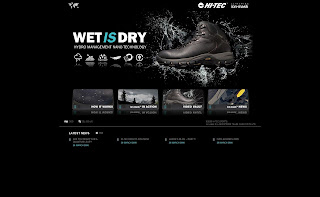
Hi-Tec ion-mask™ homepage.

Hi-Tec ion-mask™ in action.
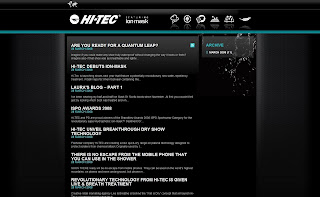
Hi-Tec ion-mask™ news.
The Hi-Tec ion-mask™ footwear range represents a quantum leap in footwear technology and has already created a stir within the industry. A breakthrough in surface enhancement, the ion-mask™ process - developed by P2i Ltd - works at a molecular level binding invisibly to the surface of the shoes giving them an extraordinary ability to repel most liquids. With the technology allowing for a lighter, cleaner, more breathable and environmentally friendly product, Hi-Tec is already taking the outdoor market by storm with record orders.
Representing possibly one of the biggest technology launches the industry has seen, the website will present visitors with animated information on the benefits of ion-mask™ and includes a show reel, press stories and a blog written by Hi-Tec, which will communicate latest news, personal opinion and brand messages, whilst encouraging consumer interaction and brand engagement.
Michael Brandreth, Senior Account Director at Bluhalo, says ‘Hi Tec briefed us to produce a site that not only communicates the fantastic consumer benefits of ion-mask™ but that also helps self-generate its own traffic. As part of a phased launch, we will introduce social media techniques to the site that will compliment the existing content and help drive awareness levels’.
Jason Larke, Group Brand Communications Manager at HI-TEC, says ‘ion-mask™ is a truly revolutionary technology in every sense and HI-TEC has been at the forefront of its development. The applications of the technology are immense matched only in its ability to capture attention. It’s just that cool! After a lengthy process we felt that Bluhalo was best equipped to not only deliver a dynamic and functional site but also to provide the backbone for communicating to a wider audience through a fully integrated social media strategy.’
The website has been designed to deliver a dynamic and enticing experience and provides a stylish and innovative platform from which to communicate the revolutionary nature of the ion-mask technology. The website will form the core of an online campaign launching the Hi-Tec ion-mask™ footwear range.

Hi-Tec ion-mask™ homepage.

Hi-Tec ion-mask™ in action.

Hi-Tec ion-mask™ news.
The Hi-Tec ion-mask™ footwear range represents a quantum leap in footwear technology and has already created a stir within the industry. A breakthrough in surface enhancement, the ion-mask™ process - developed by P2i Ltd - works at a molecular level binding invisibly to the surface of the shoes giving them an extraordinary ability to repel most liquids. With the technology allowing for a lighter, cleaner, more breathable and environmentally friendly product, Hi-Tec is already taking the outdoor market by storm with record orders.
Representing possibly one of the biggest technology launches the industry has seen, the website will present visitors with animated information on the benefits of ion-mask™ and includes a show reel, press stories and a blog written by Hi-Tec, which will communicate latest news, personal opinion and brand messages, whilst encouraging consumer interaction and brand engagement.
Michael Brandreth, Senior Account Director at Bluhalo, says ‘Hi Tec briefed us to produce a site that not only communicates the fantastic consumer benefits of ion-mask™ but that also helps self-generate its own traffic. As part of a phased launch, we will introduce social media techniques to the site that will compliment the existing content and help drive awareness levels’.
Jason Larke, Group Brand Communications Manager at HI-TEC, says ‘ion-mask™ is a truly revolutionary technology in every sense and HI-TEC has been at the forefront of its development. The applications of the technology are immense matched only in its ability to capture attention. It’s just that cool! After a lengthy process we felt that Bluhalo was best equipped to not only deliver a dynamic and functional site but also to provide the backbone for communicating to a wider audience through a fully integrated social media strategy.’
What is Social Media and Web 2.0?
Getting your website found online isn’t just about PPC and SEO. Now often termed ‘traditional’ online marketing tools, they are just the tip of the iceberg when it comes to the wealth of digital marketing tools available.
So where do you start? Why not with one of the most talked about phenomenon in recent months – social media…
What is Social Media?
Social Media is the marketing term that has been given to a breed of online websites that facilitate greater interaction with an online audience. Social Media sites allow two-way interaction between online content owners and their audience. It enables website visitors to engage, interact and contribute to content. It also enables site owners to syndicate content out to other sites and online channels, and gives them the ability to easily aggregate relevant, related content from other sources into their own sites.
What is Web 2.0?
Web 2.0 is the term given to the tools and techniques that form the core of many Social Media sites and channels. Techniques such as Blogs, Social Bookmarking, Syndication, RSS, and Aggregation are some of the popular terms that you may have heard of. However, there are also many more available to you as a business.
What does this mean to you as a business?
By empowering your audience with the ability to contribute to the content on your site, you will gradually build a strong relationship with them and develop brand loyalty. The web is no longer a faceless medium. In doing this, you will become an authority in your market sector and you will build trust through personal recommendation and the informed opinions available on your site. Your employees will feel more valued through recognition of their contribution and you will build a more personal bond with your customers through better engagement on a real-time level.
How can I use Social Media?
A clearly defined Social Media strategy will identify the Social Media channels that will best engage your stakeholders, from employees and clients, to suppliers and investors.
So what can I do?
Here are a few tried and tested techniques that you can use to start embracing social media:
1. Write a blog
You’re reading this one, so that’s proof enough that they work! Blogs are a great way of informally communicating with your audience, and they cost nothing more than your time! They’ll also improve your SEO, which is always a good thing!
2. Get Digging
Add social bookmarking tools to all of your news and product pages which will allow your visitors to easily bookmark and share your content with their own networks. Sites such as Digg and Del.icio.us are a good starting point.
3. YouTube
Youtube now receives more traffic than Google.com. That’s proof enough that user generated content (UGC) is fuelling the new web. Try and think of unique and novel ways that you can use YouTube to promote your products and services.
4. Twitter
Twitter is a great way of keeping tabs on your friends, colleagues and workforce. Many people don’t get it initially, but once you do, you’ll be hooked!
5. Get Networking
Sites such as LinkedIn, Plaxo and Facebook are amazing resources for getting in touch with people, generating leads, raising brand awareness and much more. They’re also becoming powerful business to business (B2B) tools, enabling companies to effortlessly communicate with their stakeholders.
So how do I know what to use?
That’s where we come in. With a wealth of digital marketing experience, we’re the right people to talk to about all of the above and more. To see what Evolve can do for your business online, please drop me an email: oliver@bluhalo.com
So where do you start? Why not with one of the most talked about phenomenon in recent months – social media…
What is Social Media?
Social Media is the marketing term that has been given to a breed of online websites that facilitate greater interaction with an online audience. Social Media sites allow two-way interaction between online content owners and their audience. It enables website visitors to engage, interact and contribute to content. It also enables site owners to syndicate content out to other sites and online channels, and gives them the ability to easily aggregate relevant, related content from other sources into their own sites.
What is Web 2.0?
Web 2.0 is the term given to the tools and techniques that form the core of many Social Media sites and channels. Techniques such as Blogs, Social Bookmarking, Syndication, RSS, and Aggregation are some of the popular terms that you may have heard of. However, there are also many more available to you as a business.
What does this mean to you as a business?
By empowering your audience with the ability to contribute to the content on your site, you will gradually build a strong relationship with them and develop brand loyalty. The web is no longer a faceless medium. In doing this, you will become an authority in your market sector and you will build trust through personal recommendation and the informed opinions available on your site. Your employees will feel more valued through recognition of their contribution and you will build a more personal bond with your customers through better engagement on a real-time level.
How can I use Social Media?
A clearly defined Social Media strategy will identify the Social Media channels that will best engage your stakeholders, from employees and clients, to suppliers and investors.
So what can I do?
Here are a few tried and tested techniques that you can use to start embracing social media:
1. Write a blog
You’re reading this one, so that’s proof enough that they work! Blogs are a great way of informally communicating with your audience, and they cost nothing more than your time! They’ll also improve your SEO, which is always a good thing!
2. Get Digging
Add social bookmarking tools to all of your news and product pages which will allow your visitors to easily bookmark and share your content with their own networks. Sites such as Digg and Del.icio.us are a good starting point.
3. YouTube
Youtube now receives more traffic than Google.com. That’s proof enough that user generated content (UGC) is fuelling the new web. Try and think of unique and novel ways that you can use YouTube to promote your products and services.
4. Twitter
Twitter is a great way of keeping tabs on your friends, colleagues and workforce. Many people don’t get it initially, but once you do, you’ll be hooked!
5. Get Networking
Sites such as LinkedIn, Plaxo and Facebook are amazing resources for getting in touch with people, generating leads, raising brand awareness and much more. They’re also becoming powerful business to business (B2B) tools, enabling companies to effortlessly communicate with their stakeholders.
So how do I know what to use?
That’s where we come in. With a wealth of digital marketing experience, we’re the right people to talk to about all of the above and more. To see what Evolve can do for your business online, please drop me an email: oliver@bluhalo.com
Wednesday, 7 May 2008
Multimedia Trends
Whether or not it is indicative of a larger marketwide trend, we are definitely noticing a pattern in terms of what we are producing in the office.
Although not common, we used to be asked to produce entire sites in flash. This no longer happens (or at least, it no longer happens for externally facing ones – there are exceptions for intranets and applications, but more on the latter in a bit). Instead, it is becoming the domain of the microsite. In fact, we have been working on a couple of these microsites recently (one of which recently went live for Hi-Tec, complete with wooshy effects and sounds!). This is great for having a bit of life on your site, without the risks to rankings etc that are normally associated with flash only sites.
Another thing I have noticed a steady increase in is 3d. I have mentioned this before, and not as an attempt to encourage everyone to start requesting 3d online flash apps, but rather to point to a definite upwards trend. This has in part been sparked by the papervision library for flash, but in a broader sense seems to have been sparked by general demand. This is indicated by Adobe's announcement of support for simple 3d in the next version of flash.
On the subject of Adobe and announcements, they have recently made announcements (http://www.regdeveloper.co.uk/2008/05/01/adobe_open_access_protocols/) that should help in the development of multimedia apps for mobile phones. As the article mentions, there are also technologies such as JavaFX and Microsoft's Silverlight with an eye to mobile content. While most people don’t tend to associate the mobile with multimedia content, phones are becoming ever more capable of displaying it; any help in the propagation of multimedia content across the mobile format is welcome in my opinion. Another help would be cheaper mobile data bills, buts that’s another blog entirely!
Also covered in the above announcement is Air; and so we find ourselves back at what I touched on before - applications (It’s like I planned this or something!). Basically, Air can be considered as a flash player for the desktop (as opposed to a browser). This allows people to write applications using technology they are comfortable with for what is effectively a different target platform. Potentially it means that you can provide consumers with a desktop, offline hook-up to an online service. Now, this isn’t quite what I had touched on before – Air wasn’t ready when we were required to start the project in question. In our case, we are writing a C# application that acts a wrapper to a Flash / Flex application (by communicating with a database). However, the announcement does touch on the opening up of the player to better allow this kind of development.
This isn’t to say there is not more traditional multimedia being built – people still request video players / audio players. It does however suggest that the focus is always changing and evolving as people try to find the best way to deliver their message to the public.
Ps. – request more 3d…
Nick
Although not common, we used to be asked to produce entire sites in flash. This no longer happens (or at least, it no longer happens for externally facing ones – there are exceptions for intranets and applications, but more on the latter in a bit). Instead, it is becoming the domain of the microsite. In fact, we have been working on a couple of these microsites recently (one of which recently went live for Hi-Tec, complete with wooshy effects and sounds!). This is great for having a bit of life on your site, without the risks to rankings etc that are normally associated with flash only sites.
Another thing I have noticed a steady increase in is 3d. I have mentioned this before, and not as an attempt to encourage everyone to start requesting 3d online flash apps, but rather to point to a definite upwards trend. This has in part been sparked by the papervision library for flash, but in a broader sense seems to have been sparked by general demand. This is indicated by Adobe's announcement of support for simple 3d in the next version of flash.
On the subject of Adobe and announcements, they have recently made announcements (http://www.regdeveloper.co.uk/2008/05/01/adobe_open_access_protocols/) that should help in the development of multimedia apps for mobile phones. As the article mentions, there are also technologies such as JavaFX and Microsoft's Silverlight with an eye to mobile content. While most people don’t tend to associate the mobile with multimedia content, phones are becoming ever more capable of displaying it; any help in the propagation of multimedia content across the mobile format is welcome in my opinion. Another help would be cheaper mobile data bills, buts that’s another blog entirely!
Also covered in the above announcement is Air; and so we find ourselves back at what I touched on before - applications (It’s like I planned this or something!). Basically, Air can be considered as a flash player for the desktop (as opposed to a browser). This allows people to write applications using technology they are comfortable with for what is effectively a different target platform. Potentially it means that you can provide consumers with a desktop, offline hook-up to an online service. Now, this isn’t quite what I had touched on before – Air wasn’t ready when we were required to start the project in question. In our case, we are writing a C# application that acts a wrapper to a Flash / Flex application (by communicating with a database). However, the announcement does touch on the opening up of the player to better allow this kind of development.
This isn’t to say there is not more traditional multimedia being built – people still request video players / audio players. It does however suggest that the focus is always changing and evolving as people try to find the best way to deliver their message to the public.
Ps. – request more 3d…
Nick
Thursday, 17 April 2008
Hi-Tec Press Coverage
Following our recent press release and blog article, the Hi-Tec website launch has been well received by the industry, with press coverage today in New Media Age.

Here is the article featured in NMA, 17th April, 2008.

Monday, 7 April 2008
Adding some polish - video and multimedia
Since the introduction of Flash 8 and its video capabilities the internet has seen a sudden boom of video content, with the most obvious site being youtube. With these new capabilities the more coded minded developers were intrigued by such techniques as streaming, whereas the more creative individuals were excited about the potential of introducing video graphics into flash projects. I fall into the latter category and feel that my role complements the qualities and methods of the lead multimedia developer producing content managed and visually striking applications.
Combining Flash and After Effects (a video motion graphic package) can produce high quality results. By using this method, more advanced features of After Effects can be imported into Flash. For example, here at Bluhalo this technique was used for a Littlewoods multimedia CD and subtly in both www.hi-tec.com/ion-mask and http://www.avenir-telecom.co.uk/. See if you can tell the difference?
However, with anything that is “good for you” there is usually also a downside. By creating refreshing motion graphics in this manner, it can increase the download time for websites. However, if developed with this in mind, a combination of both the ‘wow factor’ and realistic download speeds can be achieved.
Actually producing the final article can be problematic with unexplainable peculiarities with both importing and exporting. A bit of creative thinking and these can be easily overcome.
Overall, as the popularity of broadband continues to increase, the demand for rich media content will grow, as will the boundaries for video integration.
Combining Flash and After Effects (a video motion graphic package) can produce high quality results. By using this method, more advanced features of After Effects can be imported into Flash. For example, here at Bluhalo this technique was used for a Littlewoods multimedia CD and subtly in both www.hi-tec.com/ion-mask and http://www.avenir-telecom.co.uk/. See if you can tell the difference?
However, with anything that is “good for you” there is usually also a downside. By creating refreshing motion graphics in this manner, it can increase the download time for websites. However, if developed with this in mind, a combination of both the ‘wow factor’ and realistic download speeds can be achieved.
Actually producing the final article can be problematic with unexplainable peculiarities with both importing and exporting. A bit of creative thinking and these can be easily overcome.
Overall, as the popularity of broadband continues to increase, the demand for rich media content will grow, as will the boundaries for video integration.
Thursday, 13 March 2008
Flex... ah ha?

Many people have heard of “Flash” within the context of the internet. Not so many people have heard of Flex. So what is it? To the end user it appears to be the same thing - Flex compiles to the same format (you use the flash player to view Flex application) and it uses the latest, greatest version of Actionscript as Flash does, but there are fundamental differences.
The biggest of these, is that we can no longer hum the Flash Gordon tune when someone mentions it. Less importantly, the focus is different. Flash has evolved to be about wooshy things. It is at its best with pretty, moving things and adding interactivity to said moving things. Developing in flash generally requires creating movieclips and then moving them about. Flex changes this; and seems to have been written with business applications and speed of development more in mind. Certainly much of what I have read indicates that intranet applications benefit greatly from Flex development.
We have recently started using Flex for its first in-house project, and deadlines have meant that the time I had to put it through its paces before-hand was severely limited. The honeymoon period of the first few minutes, all was sunshine and rainbows. In much the same way as building a .NET application, you can drag what you need (e.g. form items which are neat little self contained components) into your design window. These components mean that things like date selectors can be very quickly added, rather than writing a proprietary one (or using one from an in-house, but still custom, library). If you prefer to get your hands dirty, you can also view the source of this page and construct the application by creating what is effectively an xml document. This will no doubt be the preferred method for programmers, but it’s very useful to have the choice especially if you wish to then pass it over to developers to pretty it up or add style sheets.
Among the first things I missed were the ability to zoom into the design panel, or being able to draw shapes directly onto the stage. Fortunately, the project in question had little need for dinosaurs running about all over the place so this wasn’t an issue. Also, this was more than made up for by the code auto-complete offered by the editor. I have since learned that some people use the Flex Builder purely to write and edit Actionscript for Flash application solely because of the convenience of this auto-complete.
Nonetheless, to my lasting joy, I was still given many opportunities to reacquaint myself with Google. Little problems (e.g. editing data in datagrids – a way of displaying tabular information – using drop down lists) kept tripping me up. Sometimes the answers were deceptively simple but other times they were somewhat depressing (on more than one occasion, I have found that the problem was with the Flex compiler itself and not in my code – especially frustrating when I then learn it was only fixed in a later version). Another slight bother has been that it seems to be slightly slower to actually render a particularly busy page than flash was, but there are solutions to this and it may become less of an issue with more experience.
During the initial learning curve, the potential gain in development time has been offset by the need to learn the various foibles of Flex development. However, these benefits have been missed on the occasions where I have flitted back to Flash to modify something that could have been better written in Flex.
Ultimately, Flex is just a tool that like any tool only offers its true benefits when used correctly. However, when used correctly Flex could be a valuable tool in the Bluhalo digital belt.
Monday, 18 February 2008
A Viral Game Review - Pancake Panic in the Spotlight
As a multimedia Developer/Designer building a game is something that can be both fulfilling graphically and mechanically. So when I was asked to design and develop a game for Shrove Tuesday I was “flipping” (sorry) excited.
The idea was to make it viral and simple, with the motive of grinding businesses across the UK to a halt (plus getting traffic to bluhalo.com and increasing brand awareness). It does give me immense satisfaction when people pop their head over a monitor to inform their colleague that they have just beaten their top score!
As with most projects the deadline was tight. However, I was pleased with the final outcome. I was particularly pleased with the look and feel of the game, giving it a sense of fun and humor. As for the technical side I am quietly content as this has been the first game I have created independently of others.

In hindsight (what a wonderful concept!) there are a couple of functionality features that may have improved the Pancake Panic experience. I believe a hi-score table would have added an extra depth of competition, not only with your colleagues but with the nation. Another idea which may have hindered the concept of a quick click and play was to take an accumulative score from three flips.
Overall the campaign was a success with a high volume of traffic playing Pancake Panic (bluhalo.com visits actually doubling over the couple of days when the game was launched). I look forward to making the next festive game for Bluhalo and future clients and although Shrove Tuesday has left us behind, feel free to have a play at www.bluhalo.com/pancake_panic - enjoy!
Fenn
The idea was to make it viral and simple, with the motive of grinding businesses across the UK to a halt (plus getting traffic to bluhalo.com and increasing brand awareness). It does give me immense satisfaction when people pop their head over a monitor to inform their colleague that they have just beaten their top score!
As with most projects the deadline was tight. However, I was pleased with the final outcome. I was particularly pleased with the look and feel of the game, giving it a sense of fun and humor. As for the technical side I am quietly content as this has been the first game I have created independently of others.
In hindsight (what a wonderful concept!) there are a couple of functionality features that may have improved the Pancake Panic experience. I believe a hi-score table would have added an extra depth of competition, not only with your colleagues but with the nation. Another idea which may have hindered the concept of a quick click and play was to take an accumulative score from three flips.
Overall the campaign was a success with a high volume of traffic playing Pancake Panic (bluhalo.com visits actually doubling over the couple of days when the game was launched). I look forward to making the next festive game for Bluhalo and future clients and although Shrove Tuesday has left us behind, feel free to have a play at www.bluhalo.com/pancake_panic - enjoy!
Fenn
Monday, 21 January 2008
Ten steps to a cooler website
As hard as it is to believe, dinosaurs, aliens and lasers aren't always appropriate on websites. So when these sure-fire instillers of coolness are taken out of the equation, what can we fall back on?
In no particular order, what follows is a short list of things I feel, if properly executed, can give sites an edge in the coolness stakes.
1. Video
They say a picture is worth a thousand words. If that picture is updating itself 24 times a second, and is saying words as well, there is a tremendous amount of information it can convey.
2. Games
Natural proponents of the "woosh" factor, games are cool. Again it ultimately comes down to execution, but games are more often that not worth the investment they require.
3. Drag and drop
It's not always appropriate, but allowing users to build queries or complete forms can greatly improve ease of use and enhance the user experience while still eliciting the "hey, that's cool" response.
4. Motion graphics
Wait, isn't that just video? No - rather than filmed / edited material, here we are talking about computer animation to give a bit of life to the page. A huge amount of complexity isn't always required, sometimes it's the simple things that aren't noticed at first that impress. Then again, something of great intricacy will produce the "wow" the first time...
5. 3d
Almost by definition, 3d is cool. Displaying products? It will allow the user to explore the item with unparalleled freedom. I have also seen some particularly cool proof of concepts for 3d user interfaces.
6. Interactive applications
Quite broad sounding, fun little applets can be cool, and quite viral in their own right. I have lost count of the number of people who have their own Simpsons avatar, for example.
7. Customisable layout
Allowing the user to configure your site to suit their own needs and preferences is very Web 2.0. As much as buzzwords like "web 2.0" are en vogue at the moment, this is still a cool feature which isn't used as often as it could or should.
8. Customisable sharable content
Allowing the user to personalise something and then share it with others can be natty feature which drives traffic and gets others interested. An example of this I have just been pointed to is http://www.potatoparade.co.uk/
9. Responsiveness
If you are suffering a slow connection, the graphics heavy site you are perusing can take ages to render every time you update a page or submit a form. Some well placed asynchronous AJAX goodness can alleviate this and give some cool results.
10. Design
It can have the best features, the most wooshy noises and still suffer in terms of coolness if the appearance isn't up to scratch.
There you have it - probably not comprehensive, but I only had 10 spaces so I had to drop gems like a friends’ suggestion of ice cubes in the server. Nonetheless, this could useful if you need to up your coolness ante…
Nick
In no particular order, what follows is a short list of things I feel, if properly executed, can give sites an edge in the coolness stakes.
1. Video
They say a picture is worth a thousand words. If that picture is updating itself 24 times a second, and is saying words as well, there is a tremendous amount of information it can convey.
2. Games
Natural proponents of the "woosh" factor, games are cool. Again it ultimately comes down to execution, but games are more often that not worth the investment they require.
3. Drag and drop
It's not always appropriate, but allowing users to build queries or complete forms can greatly improve ease of use and enhance the user experience while still eliciting the "hey, that's cool" response.
4. Motion graphics
Wait, isn't that just video? No - rather than filmed / edited material, here we are talking about computer animation to give a bit of life to the page. A huge amount of complexity isn't always required, sometimes it's the simple things that aren't noticed at first that impress. Then again, something of great intricacy will produce the "wow" the first time...
5. 3d
Almost by definition, 3d is cool. Displaying products? It will allow the user to explore the item with unparalleled freedom. I have also seen some particularly cool proof of concepts for 3d user interfaces.
6. Interactive applications
Quite broad sounding, fun little applets can be cool, and quite viral in their own right. I have lost count of the number of people who have their own Simpsons avatar, for example.
7. Customisable layout
Allowing the user to configure your site to suit their own needs and preferences is very Web 2.0. As much as buzzwords like "web 2.0" are en vogue at the moment, this is still a cool feature which isn't used as often as it could or should.
8. Customisable sharable content
Allowing the user to personalise something and then share it with others can be natty feature which drives traffic and gets others interested. An example of this I have just been pointed to is http://www.potatoparade.co.uk/
9. Responsiveness
If you are suffering a slow connection, the graphics heavy site you are perusing can take ages to render every time you update a page or submit a form. Some well placed asynchronous AJAX goodness can alleviate this and give some cool results.
10. Design
It can have the best features, the most wooshy noises and still suffer in terms of coolness if the appearance isn't up to scratch.
There you have it - probably not comprehensive, but I only had 10 spaces so I had to drop gems like a friends’ suggestion of ice cubes in the server. Nonetheless, this could useful if you need to up your coolness ante…
Nick
Thursday, 8 November 2007
The constraints, or not, of multimedia...
What can be done with multimedia? What can't be done with multimedia? Just what exactly is multimedia? Generally, the multimedia team will respond to the last question with "flash!", or perhaps "after effects!!" if we think we can get away with the file size. Technically, it could be anything made up of more than one type of media, but in actuality it's a little bit different in terms of the work we might get. At one stage, we might have been tasked with creating a gallery with the capacity to view larger versions of each image. Because of this potential diversity, I personally tend to stick with the definition as being "something cool and whooshy." The latter part is heavily re-enforced by one of our multimedia team who does indeed make "whoosh" noises as he previews and tests his work.
So what can't be done with multimedia? One of the big downsides (when using flash for example) has been search engine compatibility - a compiled flash object isn't easily indexable by a search engine. Some progress was made with this by including the text from the flash movie in the code that embedded it on the page, although this isn't a very elegant solution.
It is better solved in other ways - in the case of the gallery example above, the proliferation of the light box means this can be better achieved via javascript. It isn't even restricted to just images - you can give 'whooshy' windowed effects to all sorts of media in this way. While I don't know for sure how search engines handle the light box content, (they seem to be a law unto themselves) the form in which it is stored / presented means that at the very least the host page is indexable. Another example of overcoming this would be silverlight (into which we will delve more in another gripping blog instalment). The content is described in a XAML file which means that it is completely search engine friendly.
Another thing that multimedia (and by extension flash) was always a bit hazy on was 3d. There was always shockwave, but the steadily rising plug-in size meant that it largely lost out to its younger and smaller brother (that said, there are some fairly impressive recent examples out there). Given the steady improvement of pc components, 3d is even coming to the more commercially accepted flash, currently in the form of externally created api's like papervision, and later with an integrated engine in version 10 of the player. There is a lot of interest in this particular new and shiny aspect with ever-more-impressive demos and examples being released on a regular basis.
Accessibility can suffer, unless it is consciously worked into the design and construction, but even then it often pales next to that offered by straight html. That aside, the obvious answer to what can't be done by multimedia would be "create an ad that isn't annoying."
What can be done with multimedia? Well, given time, what can you imagine?
Nick N
So what can't be done with multimedia? One of the big downsides (when using flash for example) has been search engine compatibility - a compiled flash object isn't easily indexable by a search engine. Some progress was made with this by including the text from the flash movie in the code that embedded it on the page, although this isn't a very elegant solution.
It is better solved in other ways - in the case of the gallery example above, the proliferation of the light box means this can be better achieved via javascript. It isn't even restricted to just images - you can give 'whooshy' windowed effects to all sorts of media in this way. While I don't know for sure how search engines handle the light box content, (they seem to be a law unto themselves) the form in which it is stored / presented means that at the very least the host page is indexable. Another example of overcoming this would be silverlight (into which we will delve more in another gripping blog instalment). The content is described in a XAML file which means that it is completely search engine friendly.
Another thing that multimedia (and by extension flash) was always a bit hazy on was 3d. There was always shockwave, but the steadily rising plug-in size meant that it largely lost out to its younger and smaller brother (that said, there are some fairly impressive recent examples out there). Given the steady improvement of pc components, 3d is even coming to the more commercially accepted flash, currently in the form of externally created api's like papervision, and later with an integrated engine in version 10 of the player. There is a lot of interest in this particular new and shiny aspect with ever-more-impressive demos and examples being released on a regular basis.
Accessibility can suffer, unless it is consciously worked into the design and construction, but even then it often pales next to that offered by straight html. That aside, the obvious answer to what can't be done by multimedia would be "create an ad that isn't annoying."
What can be done with multimedia? Well, given time, what can you imagine?
Nick N
Subscribe to:
Posts (Atom)


